Hội An City, Quảng Nam Province
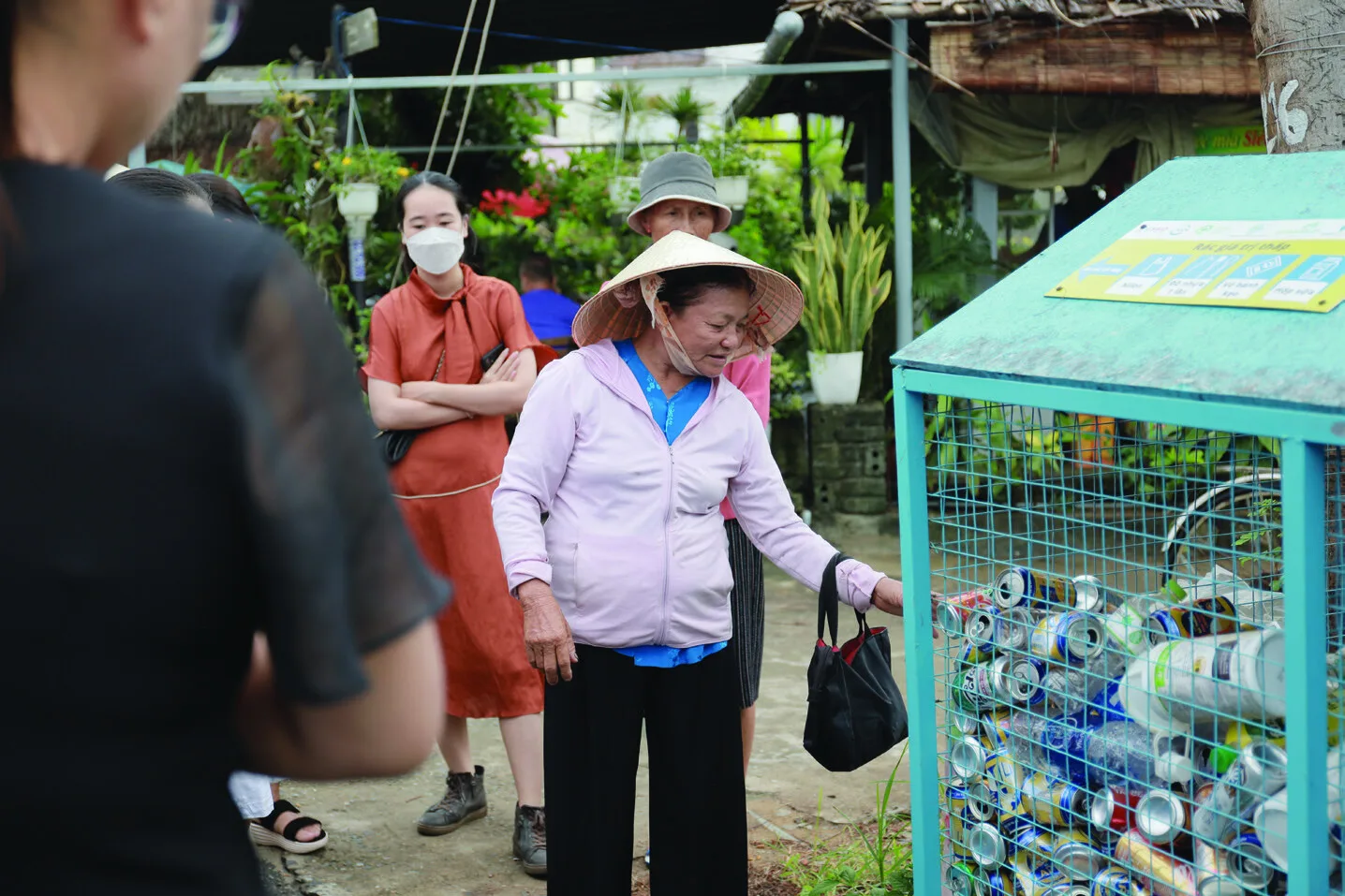
The Green House model for collecting and sorting recyclable plastic waste in Hội An City, Quảng Nam Province, with 54 green houses managed by women's union chapters and the participation of many parties.
The process of building and operating the Green House model in Hội An was carried out through the steps below:
When starting to deploy activities, the project worked with the local authorities and conducted surveys, interviews and consultation meetings with relevant partners in Hội An to assess the current state of the problem and identify partners who could cooperate in deploying activities. After assessment, the Green House model for collecting and sorting recyclable waste was designed and deployed. The model involves many parties in Hội An city, including:
The project held discussions with the Hội An Department of Natural Resources and Environment, the Women's Union, the International Union for Conservation of Nature and the enterprise Reform on the cooperation mechanism, coordinated activities and resource allocation. After working, consultation and exchange sessions, a joint action plan among the parties was established to build and operate the model.
The activities deployed to build and operate the model include:
To serve the tracking of collection quantities, the project designed a Recyclable Waste Collection Logbook for the 54 women's union chapters operating the model and the transport partners and recycling facility. In addition, the locations of the 54 Green Houses were also located on a digital map, convenient for tracking and monitoring.
To evaluate the model's effectiveness, the project supported evaluation tools, assigned project staff to accompany throughout and regularly track, update data, images and reports. From there, it proposed exchange and lessons-learned meetings and organized commendations for individuals and collectives operating the model well.
After six months of implementing the model activities, the project team organized an activity to evaluate the implementation results against the plan, while strengthening learning and adaptation in operating the model.
The SWOT (strengths, weaknesses, opportunities and threats) evaluation tool was used to evaluate the results and operating process of the model, toward supporting enhanced operational effectiveness and serving as a foundation for replicating the model.
From the outset the model was implemented at 54 points across Hội An city, and continues to be shared and replicated to other areas. In February 2023, the leaders of Hội An city received a delegation of leaders from Cần Giờ district who came to visit and learn about the model.
After the project was handed over to the locality, the Hội An City Department of Natural Resources & Environment together with the Women's Union and relevant parties continued the work of promoting the operation of the Green House model, specifically:
Sorting: Waste can become a resource only when it is sorted. This is a necessary and mandatory process. Sorting waste at source needs to be promoted because:
For the Green House model, plastic waste is sorted into 2 main groups corresponding to the 2 compartments of the Green House, namely Low-value waste and High-value waste. This sorting helps make the cleaning process in the later step easier and determines the value of each type of waste.
The community is encouraged to practice the personal 5R model: Rethink, Refuse, Reduce, Reuse and Recycle. The personal 5R model guides us to live green and practice reducing plastic waste from simple things. Instead of creating a lot of plastic waste and pressuring the collection and treatment stages, we can reduce them right at the source.
However, plastic waste is still present across many areas of life. Sorting plastic waste is precisely the first step in the recycling value chain, increasing the life cycle of waste.
Collection: Waste is collected by women's union members and residents on a voluntary basis and out of a desire to contribute to reducing plastic pollution and promoting recycling locally.
Some waste sources that can be collected locally:
Criteria the collected waste must meet:
Waste, after being sorted and collected, needs to be cleaned. It must be ensured that when the waste is gathered at the Green House, it is clean and odorless. This is to avoid attracting harmful insects such as flies, mosquitoes, ants, cockroaches,… and the accumulation of bacteria and foul odors that affect the residential area.
Below are a few criteria to help determine the cleaning of waste after sorting and collection. If you cannot determine whether the waste is clean enough, answer the following questions:
Waste, after being sorted, collected and cleaned, will be folded neatly by type and placed into the Green House in the corresponding compartment.
The women's union member managing the Green House in each Hamlet/Neighborhood is responsible for checking whether the waste has been sorted and cleaned properly and weighing and measuring the amount of waste collected for tracking.
Data on collection time, type of waste, weight, funds raised,... will be recorded in the Recyclable Waste Collection Logbook. This data is recorded to track and evaluate the operating effectiveness of the Green House model at each women's union chapter. From there, suitable plans for developing and expanding the model can be proposed, while also serving the commendation and recognition work of the Hội An City Women's Union.
High-value waste at the Green House is bought and transported by scrap-collector groups to resell to recycling companies. Low-value waste is transported to the recycling facility in Hội An city.
Low-value waste is recycled in Hội An. The recycled products return to serve our lives, helping to increase the life cycle of waste and generate economic profit.
The model connected the high- and low-value waste recycling chain locally, mobilized community participation and affirmed the role of women in joining hands to reduce plastic waste in particular and solid waste in general. After the process of deploying activities within the project framework, this model achieved the following outstanding results:
The highlight of Hội An is that it has implemented and maintained waste sorting at source for many years (starting to pilot and deploy synchronously since 2012). Therefore, residents already have awareness, self-discipline as well as a certain understanding of waste sorting. This became the basis for activities developing the waste-sorting model to reach the people.
To deploy the Green House model, the locality always created favorable conditions for the project to access and coordinate implementation according to the joint action plan. The Department of Natural Resources and Environment led and connected the project with suitable partners. The Hội An City Women's Union, with experience working on previous projects and a professional working style, managed and mobilized the participation of a large number of members. The members are present throughout the residential areas. Through activities related to family care, the members communicated to convey the necessary knowledge and information about the model. From there, that information reached each resident in the area, to call for their participation and companionship. The S.E.A Club volunteer group are dynamic young people who actively participate in the transport and communication of the model. The levels of participation from management to model deployment are all closely linked and assigned by group to create unity.
However, the support of S.E.A Club volunteers is only a temporary solution. The ReForm Plastic company leaving Hội An also caused disruption in the treatment stage. Therefore, right from the second phase of the model, the Department of Natural Resources and Environment proposed organizing discussion meetings with stakeholders. After the exchange sessions, the Public Works Company agreed to participate in transporting recyclable waste from the Green Houses to the recycling facility. From June 2023, this unit began surveying and orienting the routes and schedules for the collection vehicles and soon completed the transport. In addition, some units contacted the Department of Natural Resources and Environment to propose cooperation, and GreenHub also supported connecting Hội An city with potential units.
Based on the practical reality of the process of deploying this model's activities, the project team has the following proposals to sustainably maintain and replicate similar models, specifically as follows: