Published June 30, 2026
At a small pagoda in Bắc Từ Liêm, sorting waste, composting and making enzymes have become part of spiritual practice — for here, protecting the environment is inseparable from Buddhist teaching.
Tucked away in a small alley in Phu Dien ward, Bac Tu Liem, Dinh Quan Pagoda is one of the spiritual sites that draws many monks, nuns and Buddhists in Hanoi. Throughout many years of operation, the monks and the pagoda have regularly organized meaningful charitable activities for the community with the participation of many Buddhists. From cooking charity meals and porridge to summer retreats or sightseeing visits to the pagoda, all welcome a very large number of people coming from every corner of the country. In the face of such abundant affection, the pagoda placed greater emphasis on dealing with accumulated household waste and on sorting waste at source, so as to offer a resting place close to nature and to preserve and maintain the scenery in full, as a word of thanks in return for that affection.
With the companionship of the LSPP project, implemented by the Center for Supporting Green Development GreenHub, through study sessions and practice in waste sorting, the monks in training have now become as familiar with this healthy habit as with something they do every day. For the pagoda and its monks and nuns, improving the quality of the living environment at the pagoda or training each person in a green action also contributes a touch of civilized beauty that makes this life even more wonderful. According to Venerable Thich Tinh Quan, the abbot of Dinh Quan Pagoda, before GreenHub's environmental protection project was implemented here, the pagoda had only a single type of waste bin, and because of that many kinds of recyclable waste were mixed together, such as bottles, vegetables and plastic bags, not only in the bins but also at the waste dump behind the pagoda, polluting and affecting the space for spiritual practice.
In the past, when awareness of waste was still limited, this situation was seen as a matter of course; yet as time went on, Dinh Quan Pagoda embraced positive, thorough changes in its actions by taking part in building the Zero-Waste Pagoda model. Working together with experts on this journey of renewal, the pagoda received support both in suitable equipment to optimize the sorting and circulation of waste, and in knowledge about sorting, identifying the types of waste and the journey from sorting to recycling, and applying recycling to composting organic fertilizer. The monks spent time bonding with the implementation team, acting together for a green, zero-waste pagoda and striving to completely eliminate the pollution of the waste dump behind the pagoda.
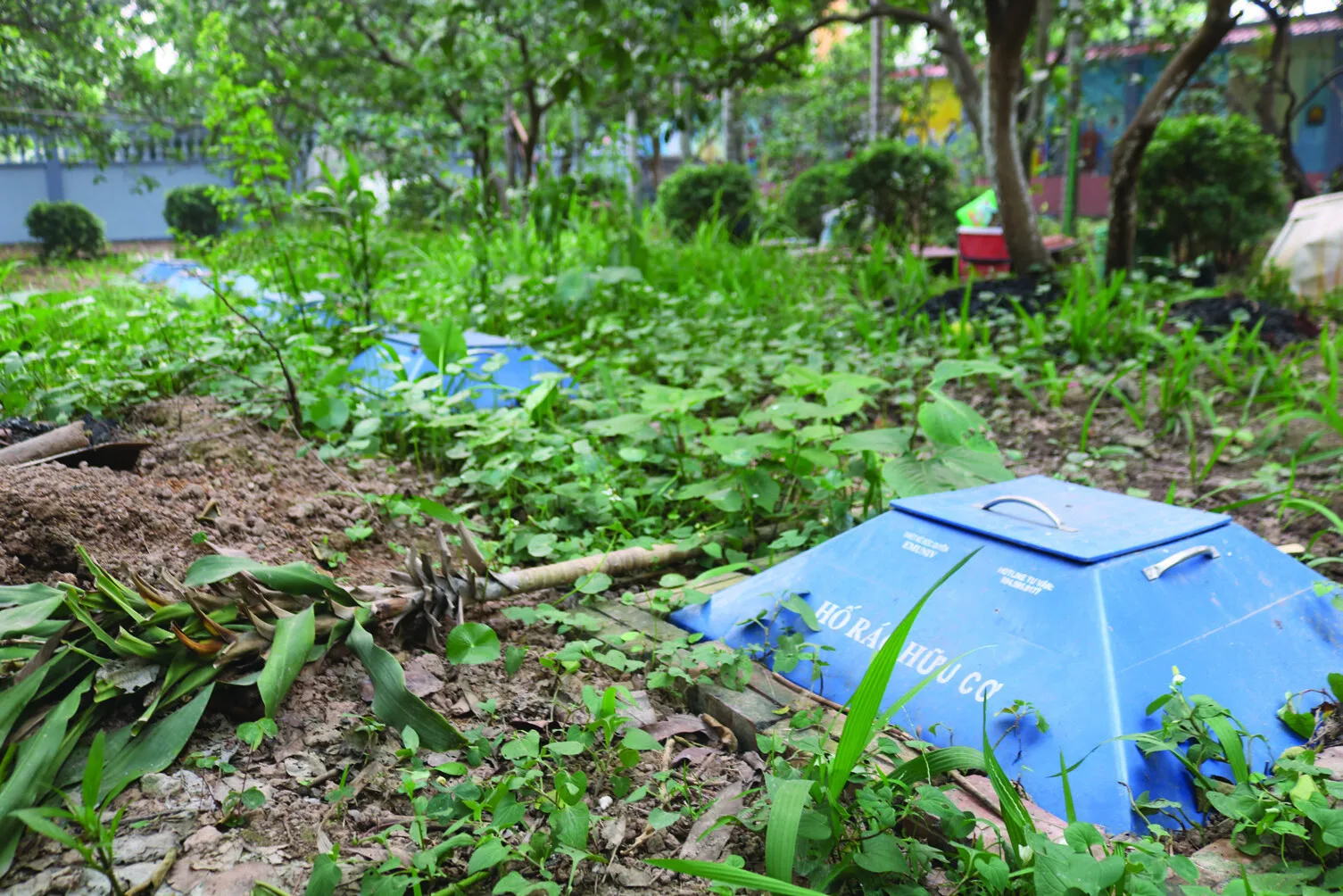
Alongside the roll-out of collection, Dinh Quan Pagoda has always been associated with peaceful scenery from its natural gardens, and so the garden within the pagoda grounds has many trees; in particular, waste from flowers and leaves accounts for more than 52% of total waste, so the monks quickly applied the techniques they had learned to bring leftover, bruised vegetables and fruit out to be composted into fertilizer for the plants. Applying green knowledge to the fullest, the pagoda worked with GreenHub to make enzymes to produce organic hand wash and dish-washing liquid, both cutting a portion of the costs and providing cleaning products that are good for health and the environment.
Every effort put in was worthily rewarded. According to figures compiled after the model had been stably implemented, Dinh Quan Pagoda estimates that in one week it collects more than 106.4 kg of waste to bring into the circular process, step by step turning waste into resources.
Renewal is a long journey, going from a successful model to maintaining it for a sustainable green lifestyle. After joining the Zero-Waste Pagoda model, the monks, nuns and Buddhists all continue to persistently spread and actively apply it in every daily activity, so that this journey may last even longer, sustainably and positively, for a green Hanoi and for an inspiring green future.
To create a more positive impact on the community of monks, nuns and Buddhists, the pagoda has combined with GreenHub to create environmental protection courses for young people who join the summer retreats at Dinh Quan Pagoda. On average, the number of participants in these retreats reaches 200 - 250 people per course, and there are about 5-6 retreats each year, so the program promises to bring enormous spreading power to the country's succeeding generation. This helps the children approach environmental issues in a suitable way, changing their behavior naturally through the purest concern for Mother Nature. The project team feels extremely happy and grateful to learn that the children are all excited and full of admiration for the practical knowledge that is “small but mighty"; collecting, recycling and protecting the environment even became a topic that sparks creativity, evoking a sense of openness toward new viewpoints and new ideas for reducing harmful impact through each small daily action of the young Buddhists.
A meaningful action will always inspire the people around it. When the zero-waste pagoda model reaped successes from practical and familiar solutions, those solutions were widely shared from the pagoda to each small home of the Dinh Quan Pagoda staff, and many local families were also encouraged to take part, creating positive impacts worthy of note. Mr. Tran Khac Hanh, a security guard at Dinh Quan Pagoda, shared his great admiration for the project's activities and affirmed that he would continue to spread the meaning of this zero-waste pagoda model even more widely, not only to his relatives but also to friends near and far whenever he has the chance, so as to join hands in minimizing the amount of waste thrown out into the environment.
Speaking of the challenges the pagoda faced in the process of carrying out the transformation of organic waste, the venerable said that the difficulty in sustaining green activities comes from the many passing visitors who do not yet have the habit of sorting waste when they come to the pagoda; therefore the Buddhists at the pagoda have always had to actively remind and raise awareness so that visitors from all directions who stop by to admire the pagoda gradually understand and gradually change together with the monks here.
The environment in Buddhism teaches everyone to know how to beautify this life and to protect a green Earth for themselves. Integrating environmental protection into Buddhism is entirely reasonable and should be promoted more strongly in the course of spiritual practice. For Buddhism does not only educate the monastics but also teaches the Buddhists to cherish the values they are holding. That is why protecting the environment is intimately connected with Buddhism. That is a great motivation for the pagoda to carry out this program.
— Venerable Thich Tinh Quan, abbot of Dinh Quan Pagoda