
Published June 6, 2026
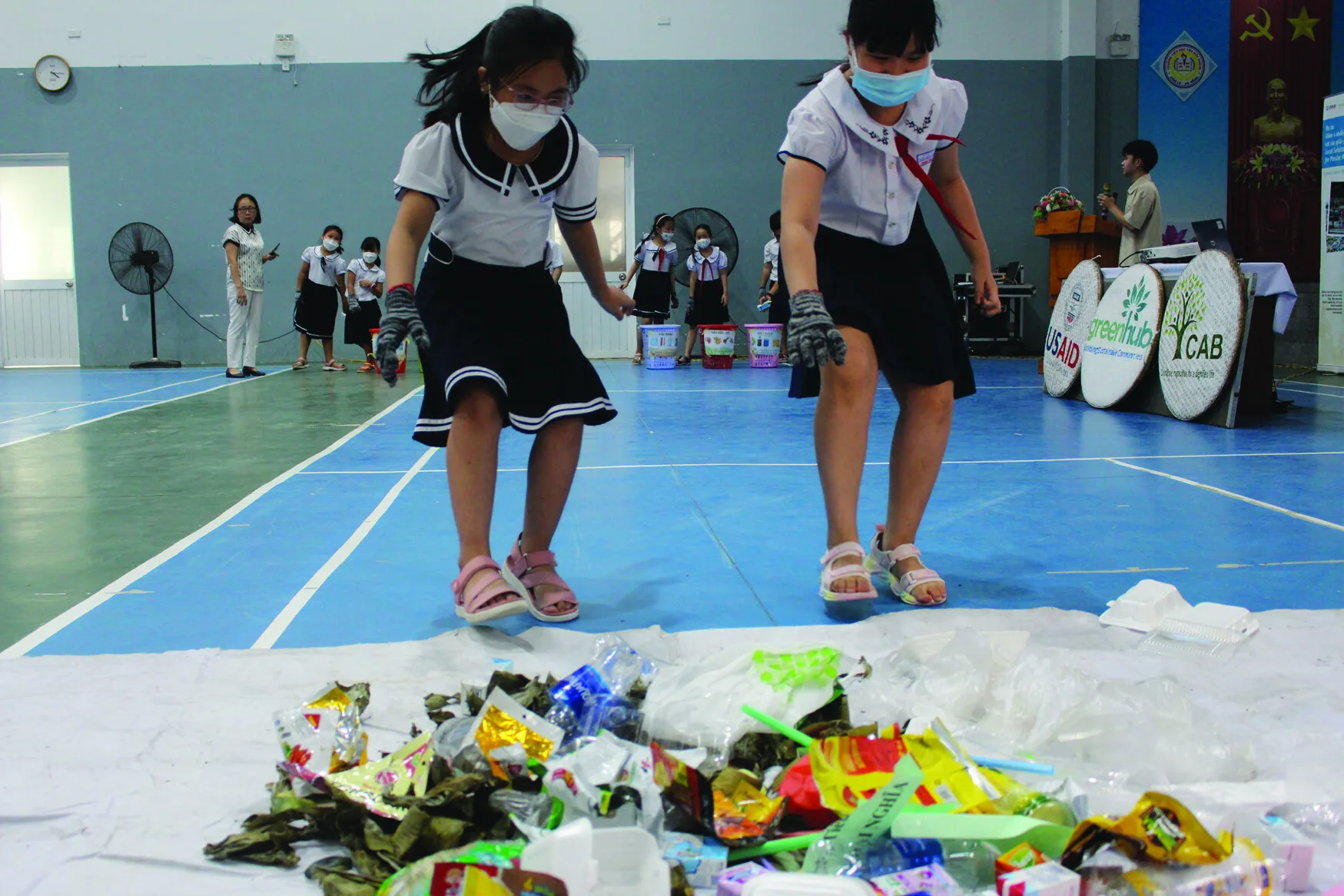
A small change — reusable lunch boxes instead of foam — multiplied across three schools in Cẩm Lệ cut waste by up to 40% and reshaped the awareness of 5,184 students and teachers.
Environmental education has long ceased to be a new story, but to sustain it and coordinate it smoothly, forming habits for children still requires far more long-term strategy in order to head toward a sustainable goal in the future. In that context, implementing Action Plan No. 133/KH-UBND and Decision No. 9083/QĐ-UBND dated 17/12/2014 on green school standards, the Cam Le District Division of Education and Training issued Plan No. 375/KH-PGDĐT to deploy the model “Green School - Say No to Plastic Waste”.
The pilot model was deployed at three primary school sites - Ton Duc Thang, Tran Van Du, and Tran Dai Nghia - in Cam Le District. Previously, all three schools had implemented many solutions to reduce plastic waste but not truly effectively or lastingly. Stemming from practical need, the schools were selected to pilot the model “Green School - Say No to Plastic Waste”. The model was jointly implemented by the Division of Education and Training, the Cam Le District Division of Natural Resources and Environment, the Green Development Support Center (GreenHub), and the Center for Adaptation Capacity Building Research (CAB).
Over the course of implementation, the model was warmly received by the Cam Le District Division of Education and Training, which intends to replicate the model across the area, using GreenHub's documentation of the model in expansion activities and regularly applying it in environmental education activities at 11 primary schools across the district.
One of the effective measures taken to reduce waste was switching from ready-bought snacks in the commonly seen styrofoam boxes, which do not ensure food safety and hygiene, to encouraging parents to let their children bring light snacks in personal reusable boxes that are safe for the children. A simple change, but it helped significantly reduce the amount of plastic waste from single-use products. Specifically, the volume of plastic waste dropped from 19.2 kg/day to 12 kg/day, a corresponding reduction of 38%.
Going back to the early days of deploying the green school model, from installation and layout to the school landscape, everything required careful calculation to ensure both greening the school and ensuring safety for the children. Alongside this were meetings and discussions on programs integrating teaching and rolling it out to students and parents.
Before it could be put into deployment and the activity plan finalized, the school's staff and workers, together with the project, were trained in measuring and managing waste in order to grasp the quantity and effectiveness after implementing the initiative. Seeing that effort and responsibility, the project team understood that the greatest motivation for the teachers is the children, for whom they change with genuine, wholehearted love.
The “greening” journey is a praiseworthy effort to promote environmental sustainability and reduce waste generation. However, this journey cannot reach its destination without the essential elements of love and responsibility going hand in hand. The noble love of the educators, as well as the love and understanding of parents, played an important role in achieving the admirable results as the initiative entered its final pilot phase at the three school sites.
Efforts focused on recycling and reusing single-use plastic products for food and drink also brought notable results. The amount of plastic waste from these items dropped from 2,836 pieces/day to 1,134 pieces/day, equivalent to a reduction of 40%.
Overall, the total volume of waste was significantly reduced after deploying the Green School model initiative. From an initial volume of 53 kg/day it dropped to 21.4 kg/day, marking a significant reduction of 40%.
Besides reducing tangible waste, there was also a marked improvement in the knowledge, attitudes, and practices of both teachers and students. Understanding of environmental issues and commitment to sustainable practices from the school's staff and workers as well as parents and students increased in a positive direction. This encouraging change is reflected in in-depth analytical reports measuring knowledge, attitudes, and practices, which improved by 20-30%.
The successful results achieved so far demonstrate the power of collective effort and the importance of love and responsibility in environmental initiatives. By fostering awareness through care, compassion, and responsibility toward the environment, educators and parents played an important role in sowing the valuable “green seed” into the young generation. This “greening” journey not only contributes to reducing waste but also contributes to building a sustainable future driven by love and responsibility.
In exchanges with the project team, the pilot schools enthusiastically shared their ceaseless dedication to sustaining the Green School model, with a scale of positive impact reaching 5,184 students and teachers. Encouraged by the good results they have experienced so far, the school sites expressed a sincere wish to sustain the model over the long term, with the ultimate aspiration that it will be replicated in the future.
The schools firmly believe that by continuing to apply the principles and practices of the Green School model, they can contribute significantly to environmental sustainability and serve as a source of inspiration for other localities across the country. Through the support and recognition of Da Nang in general and the three school sites in particular, the project team hopes to spark a movement of change that will promote the widespread adoption and implementation of similar initiatives, fostering a greener and more sustainable future for generations to come.