A4 An Binh City, Giao Luu Urban Area, Phu Dien, Hanoiinfo@greenu.vn(024) 6654 8087
GreenU
Green VillageNew
Contact us
Featured model

Eco-pagoda model

Hà Nội City

Chùa Đình Quán: Hòa hợp thuận tự nhiên

The eco-pagoda model deployed at Đình Quán Pagoda (Hà Nội City), establishing a process for sorting and treating waste right at the pagoda, turning organic waste into enzymes and fertilizer.

Implementation method

The deployment of the model at Đình Quán Pagoda was carried out through the steps below:

Step 1: Survey

  • The site survey included surveying i) waste collection points; ii) the waste flow path; and iii) the current site conditions capable of treating organic waste.
  • Outputs: 1) a site drawing, 2) a feasible organic-waste treatment plan, and 3) an explanatory note.

Step 2: Audit

The audit aims to determine the volume of waste at the pagoda each day/week, classified into 5 types of waste:

  • Organic waste from the kitchen
  • Flower and leaf waste
  • Recyclable plastic waste
  • Single-use packaging waste
  • Other waste

Step 3: Building solutions

In this step, based on the information gathered from steps 1 and 2, the expert team develops solutions for 2 main groups of work:

  • Sorting: providing solutions to promote waste sorting.
  • Treatment: providing solutions to treat (transform) certain types of waste right at the pagoda.

Outputs:

  • A report proposing renovation solutions with the following contents: a renovated site layout containing information on equipment locations and the new waste flow path.
  • An explanatory note on the renovation and treatment plan.
  • Guidance documents: a document guiding and managing sorting; a document guiding and managing treatment.

Step 4: Installation

The construction team will install the equipment (waste sorting and collection equipment, transport equipment, waste treatment equipment), accessories, painted markings, and guidance signs of all kinds.

Step 5: Training and handover

The expert team will train and hand over the management and practice of waste sorting and treatment to the management focal points as well as the users at the Pagoda.

Handover documents:

  • Guidance on waste sorting and waste treatment.
  • Guidance on managing waste sorting and treatment.

Step 6: Completion evaluation

Timing: periodically every 3 months, one session per month.

Model implementation process

Survey results

The survey at the pagoda produced the following results:

Regarding waste sources, waste mainly arises from the following points:

  • The charity cooking area
  • The internal dining area
  • The dining area of meditation students
  • The bin near the gate where Buddhists visiting the pagoda throw away waste
  • The offering-preparation area
  • Dry leaves, fallen flowers and fruit from trees

Regarding the waste flow path: the waste flow at the pagoda is quite complex and is handled by many people, both inside and outside the pagoda, from the stages of collection and gathering to treatment and disposal. The waste flow is inconsistent (each group collects, gathers and treats differently), resulting in various waste-gathering points/piles including: the mixed-waste bin area near the three-entrance gate, the waste-gathering area dumped into the ditch, and the organic-waste gathering area piled up in the garden.

Regarding sorting and treatment: the main way of handling waste is to wrap it in nylon bags and dump it into the ditch in the pagoda's garden (in front of the Tam Quan gate). For organic waste, a small amount is given to pig raisers, and some is spread into the garden to decompose naturally or gathered to be burned. Waste sorting is almost not carried out, and quite a lot of waste is still burned mixed together. The lack of sorting causes dry and wet waste to mix, so organic waste and recyclable waste cannot be utilized, while burning waste releases toxic gases harmful to the environment and everyone's health.

Audit results

Method: The waste audit was carried out by GreenHub staff in the morning over 06 days at the gathering point of 2 green bins near the entrance gate, together with the waste of one charity-cooking day.

After consultation sessions and discussions with the pagoda as well as field surveys, GreenHub found that the pagoda mainly has organic waste. For that reason, organic waste was divided into 2 main types: kitchen waste and flower/leaf waste.

Results: The types of waste were sorted according to the established categories. Each type of waste after sorting was audited by weight and volume. Data was recorded in the summary table of weight and volume of each type of waste according to the template under Appendix 1.

Proposed waste sorting and treatment solutions

Waste sorting: To sort waste, the project proposes sorting into 3 main types of waste based on the treatment sequence. Specifically:

  • Green: Organic waste (decomposable waste such as flowers, fruit, tea grounds, leaves, vegetables,…) will be treated into organic fertilizer.
  • Orange: Recyclable waste (recyclable materials such as PET plastic, HDPE,... aluminum, tin, milk cartons,..) and nylon bags will be collected and then further processed by parties specializing in buying and selling recyclable waste such as scrap collectors and collection businesses.
  • Red: Other waste (remaining waste not in the above 2 categories (glass, ceramics, brick, wood, tissue paper,...) will be collected and disposed of.

Flower and leaf waste is very abundant on days when the pagoda holds ceremonies, usually flowers such as roses, chrysanthemums, lotus… In just 6 audit days, the total flower/leaf waste discharged reached 55.71 kg. However, the actual amount of flower/leaf waste may be larger, because every week people at the pagoda still sweep leaves and gather them to put in the garden or to burn. Flower/leaf waste is often discarded while still mixed with foam, rubber bands and nylon wrap.

Organic waste from the kitchen is especially abundant on the pagoda's charity-cooking days. On ordinary weekdays, kitchen organic waste found in the bin at the audit point is almost negligible, only some fruit peels and seeds. Every Saturday, the pagoda organizes charity cooking all day to bring gifts to Hospital E. Kitchen waste after 2 charity-cooking sessions in the morning around 6 a.m. and 12 noon, with the number of charity meals reaching 200 rice boxes per session. The organic waste taken solely from the kitchen area was audited as:

  • Kitchen organic waste: 17.18 kg (100 liters)
  • Recyclable plastic waste: 0.61 kg (22.5 liters)
  • Single-use packaging waste: 1.33 kg (75 liters)
  • Other waste: 2.94 kg (20 liters)
  • The pagoda's packaging and non-recyclable plastic waste is mainly candy wrappers and incense-stick wrappers.
  • Recyclable plastic waste is also not much, mainly nylon bags and plastic bottles.
  • Among other waste, hazardous waste is almost negligible, but is still found in the common bin. Special treatment measures are needed for this type of waste despite its small quantity because its pollution level is extremely high.
  • Other waste is quite heavy because it contains broken ceramics and discarded candle cups.

For the waste sorting process to be feasible, the first thing to do is to add the necessary equipment for waste sorting. In this project, with the goal of sorting waste into 3 groups being 1) organic waste, 2) recyclable waste and 3) other waste, the project team proposed adding 2 more bins (painted yellow for recyclable waste and red for other waste) to the waste points that already had green bins (for organic waste). Thus, at each waste-gathering point there will be 03 bins of 3 different colors (green, yellow, red). Guidance boards on waste sorting are added right at the location of the bins.

To sort waste effectively, the project team redesigned the waste flow path consistently throughout the entire pagoda grounds. Based on the current collection situation and the waste-management renovation diagram, the waste flow path under the new Model will have 06 waste areas, corresponding to the waste-generating points. The process of rebuilding the waste flow in the Pagoda was consulted with the abbot as well as the monks, nuns and Buddhists living and working at the Pagoda in order to find a suitable path and obtain consensus from all relevant parties.

Waste sorting is theoretically quite simple, but when applied in practice it requires serious implementation by everyone involved for the sorting to be meaningful and effective. In particular, waste with a lot of packaging, mixed with many types of waste, needs to be separated to be placed in the corresponding bin (a flower bunch mixed with nylon, rubber bands, or food/rice bags mixed with both organic and inorganic waste…).

Waste treatment: After sorting, waste will be treated as follows:

  • Organic waste: treated directly at the pagoda into enzymes and organic fertilizer.
  • Recyclable waste: contracted out to one of the recycling collectors.
  • Other waste: taken away for disposal by environmental units.

The specific organic-waste treatment solution is as follows:

  • Fruit peels and dried flowers with essential oils will be kept to make enzymes before being put into the bin.
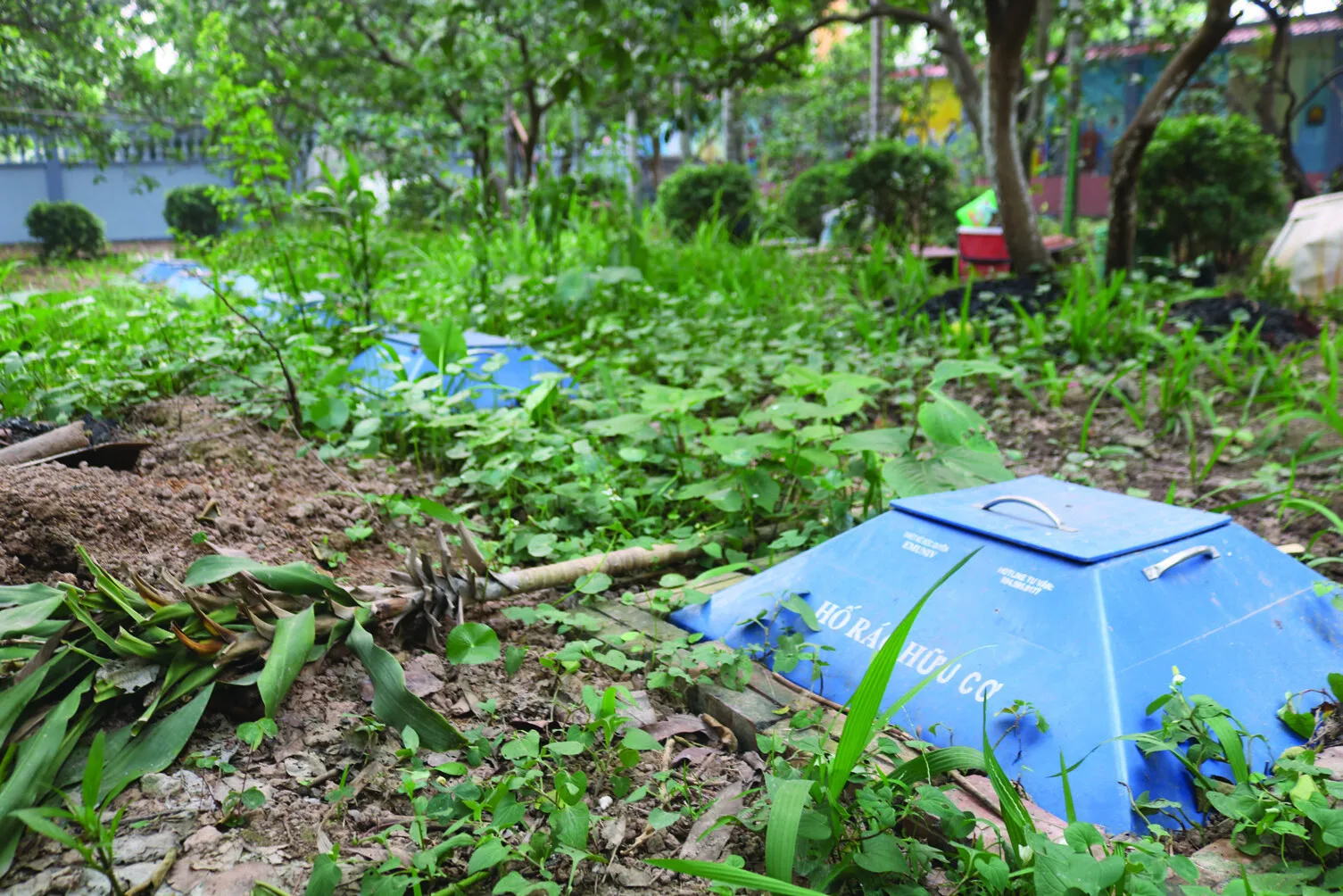
  • Organic waste will be gathered at the Tam Quan gate. Here, large-sized items will be cut small, then taken to be composted into organic fertilizer at the following locations in priority order from top to bottom: (1) Composting in half-buried bamboo tubes in the garden. (2) Composting in pre-dug compost pits with plastic lids in the garden. (3) Dumping into the backup compost pit outside the Tam Quan gate.

Hazardous waste such as batteries, accumulators, and flammable/explosive items,.. needs to be placed in separate bags to be taken away for treatment. In particular, some collection units currently accept spent batteries, so the pagoda can gather them in small boxes to give away later.

Installing the necessary equipment

After presenting and consulting on the waste sorting and treatment solutions at the Pagoda, the sorting and treatment solution group as stated above received the approval and endorsement of the Pagoda. The project team carried out the next step of additionally installing the necessary equipment described in the solution section. Specifically:

Equipment for waste sorting:

  • A system of bins holding sorted waste with specific color-coded identification and specific sorting labels affixed to the bin lids.
  • Sorting guidance boards right at the location of the bins.
  • Handheld rules and guidance on waste sorting.

Equipment for organic-waste treatment:

  • A cutting machine (including the power cable from the Pagoda to the garden): helps cut organic waste such as flowers and branches small for easy processing into organic fertilizer for plants.
  • Bamboo tubes: buried tubes to treat organic waste directly into fertilizer for fruit trees at the Pagoda. The Pagoda will treat part of the organic waste into microbial fertilizer to supplement the plants in the garden.
  • Covers for the organic-waste compost pits.
  • Drums for composting biological enzymes.

Training and handover

Training and guidance on the practice of waste sorting and treatment: Although all necessary equipment is in place, for the waste sorting and treatment process to become operational, awareness-raising activities as well as waste sorting and treatment methods are needed for the relevant parties including: the pagoda abbot, monks and nuns, Buddhists practicing at Đình Quán Pagoda, people doing volunteer work at the pagoda, and pilgrims from all over (participants in the pagoda's retreats and volunteers from universities in Hanoi).

To do this, the Project team developed and implemented several activities with content on raising awareness and guiding the sorting and transformation of waste typical at Đình Quán Pagoda, including:

  • A waste-audit activity with the participation of volunteers.
  • An 'awakening the green sprout' activity with the participation of the pagoda's retreat.
  • An activity guiding the collection and sorting of plastic waste and the production of organic fertilizer and enzyme preparations from organic waste.

The main purposes of the training and sharing activities are:

  • Volunteers know and apply the waste-audit method.
  • Evoking a love of nature and the environment in children.
  • Knowing how to use plastic items and sort waste at home.
  • The abbot, monks, nuns and Buddhists practicing at the pagoda have knowledge about waste and waste transformation such as: making organic fertilizer by composting, and making biological detergents to replace chemical detergents.

Training and guidance on model management: After being guided, the abbot, monks, nuns and Buddhists at the pagoda can basically sort and treat waste. However, for the above activity to become a permanent activity like a cultural trait, the project team carried out the process-ization of the waste sorting and treatment at the Pagoda. Accordingly, a set of guidance documents on the management process together with tools for monitoring, supervision and evaluation was built and handed over to the members of the Pagoda to implement. In this guidance document, the project team proposed a dedicated position for managing waste sorting and treatment at the pagoda with specific, clear functions and duties and a detailed job description to help the assigned person easily carry out the work.

Completion evaluation

After establishing the eco-pagoda model, the project team built a plan to evaluate periodically every 3 months to monitor and evaluate the waste sorting and transformation process at the pagoda, periodically every 3 months, once per month. The activities within the scope of the task:

  • Managing the focal points of collection and sorting at the locations where bins, waste baskets and waste tanks have been placed.
  • Managing the quantity and quality of machinery and equipment including: grass-cutting machine, cart, bins, waste baskets, enzyme containers, guidance boards.
  • Inspecting and evaluating periodically daily, weekly and monthly according to the attached template.
  • Reporting periodically monthly to the abbot.

Summary of some results

On the waste sorting process at the pagoda

  • After 6 months of implementing the model, the monitoring and evaluation results show that the waste sorting process at the pagoda proceeded exactly as the project designed. The bins are still used effectively at the designed locations, the boards are still hung neatly and waste is still sorted correctly according to the guidance on the boards.
  • Another clearly evident sorting result is that the number of waste storage containers kept at the pagoda has decreased, showing that the amount of waste effectively treated has increased significantly.

On the organic-waste treatment process at the pagoda

  • Monitoring results at the compost pits show that the pits are frequently filled with organic matter. This proves that these pits treat effectively and are frequently used.
  • Monitoring results of the bamboo-tube treatment show that these tubes are often not filled. The project team analyzed and interviewed some relevant individuals and concluded: because stuffing waste into the bamboo tubes takes much more time than stuffing it into the compost pits, members prefer to use the pits more. This is a valuable lesson for other models: when building organic-waste treatment solutions, priority should be given to solutions that take less time and effort for the operator.
  • Monitoring of organic-waste treatment also shows that the organic-waste pile buried in the garden has disappeared, replaced in that spot by a custard-apple tree that has been planted and is growing green and healthy. This proves that organic waste at the pagoda has been treated very effectively and there is no longer enough of it to pile up in the garden.

It is estimated that with an average kitchen organic-waste volume of about 17 kg on a Saturday, and other days (on average one retreat of 2 days/week) with an equivalent volume, each week the organic-waste treatment system treated about 3 x 17 = 51 kg. During the monitoring period, the amount of kitchen organic waste the system treated equals 51 kg x 24 weeks = 1224 kg = 1.22 tons of waste. The actual volume the system treated is much higher than this figure, because the system also treats all the dried flowers, grasses and dry leaves swept from the yard and garden (previously used for burning).

With a dry-matter yield of 10%, the volume of high-content organic humus the system produced is at least 120 kg, equivalent to 800 kg of 15% organic fertilizer. This is a truly impressive figure.

Lessons learned and recommendations

  • On the feasibility of the model: A green-living consciousness and waste transformation actively supported by the abbot is the basis ensuring the feasibility of implementing the model at the Pagoda.
  • Because the pagoda is a spiritual site, visitors to the pagoda are pilgrims from all over. Therefore, although there are guidance boards, visiting guests sometimes do not sort waste correctly due to a lack of awareness as well as not knowing the sorting method. Hence, the guidance needs to be specific, detailed and close to the bin location (sticking - painting - printing guidance on the bin lids,...) is necessary.
  • To achieve effective communication and awareness among people about sorting and transforming waste at the pagoda, training and knowledge-sharing sessions on waste sorting and treatment should be a part of the retreat content. Building the retreat program will include sorting and treating waste right at the pagoda in the form of a hands-on experience tour.
  • Because training and knowledge-sharing sessions on sorting and transforming waste are still limited, more guidance and training sessions are needed so that everyone understands the benefits of waste sorting, such as: accompanying the manager and those directly participating in sorting; conducting a question-and-answer process to help those directly participating in sorting see the benefits of sorting; besides the retreats, offering some programs and events that can be held at the pagoda to promote and expand the waste-sorting program.
  • The bamboo-tube model was supported by the pagoda and is effective; however, because the model is experimental, the number of bamboo tubes making fertilizer is insufficient compared to the Pagoda's needs, and the diameter of the bamboo tubes needs to be widened to make it easier to put waste into the tubes.
  • A characteristic of pagodas is having many flowering and ornamental plants. Many plant species need the care of the monks, nuns and Buddhists at the pagoda. Therefore, the solution of treating organic waste into enzymes needs to be guided in both directions: 1) guidance on making cleaning enzymes and 2) guidance on making fertilizer enzymes for the ornamental plants and flowers at the pagoda.
Beta

Our site is in its growing season — some content is still being updated. Thank you for visiting early.