The process for building and implementing the green-school-saying-no-to-plastic-waste model (Da Nang City) comprises 5 steps: (B1) Assess and analyse the context; (B2) Build a plan and reach consensus; (B3) Organise implementation; (B4) Evaluate and adjust; (B5) Document and share.
Step 1: Identify the current status and need for a green school saying no to plastic waste
In this step, the District People's Committee, the Department of Natural Resources and Environment (DoNRE) and the Department of Education and Training (DoET) review the city's issued Green School standards. Information is provided to schools in the area to register with the DoET.
In Da Nang, since 2014 the City People's Committee has issued the procedure “Selection and recognition of Green Schools for primary schools in Da Nang City” under Decision No. 9083/QD-UBND of the City People's Committee. In this procedure, criteria on waste management including communication activities, segregation and green-space areas are mandatory requirements. At the same time, the Building Da Nang - Environmental City Scheme under Decision No. 1099/QD-UBND set a target of 100% of schools performing waste segregation and building a green-school model. Cam Le District People's Committee also issued the Plan for Implementing segregation of domestic solid waste at source and reducing plastic waste in Cam Le district in 2022. This is the basis for primary schools to implement the green-school-saying-no-to-plastic-waste model.
Information on the proposed green-school-saying-no-to-plastic-waste model needs to be provided to schools through DoET activities and social-media channels to ensure schools have full information and to give all schools the opportunity to register.
Step 2: Plan the pilot implementation of the green-school-saying-no-to-plastic-waste model at selected schools
a. Selecting schools to participate in the pilot model
Based on the list of registered schools, select schools to participate in the pilot according to suitability and resources. Selected schools are chosen based on basic criteria including:
- Priority for primary schools in the District;
- Schools actively participating in environmental-protection activities;
- Schools that wish to implement the model to meet green-school criteria;
- Schools that commit to implementing all activities in the plan and ensuring continued maintenance of the model's sustainability.
After receiving registrations and reviewing the criteria, the DoNRE and DoET build the legal basis for schools to participate in implementing the model and coordinate resources such as issuing the implementation plan.
b. Building a plan agreed with the selected pilot schools
After agreeing on the participating schools, the DoNRE and DoET need to organise working sessions with the schools to agree on the implementation plan and assign the roles and responsibilities of members. In these activities, schools have the opportunity to clearly understand the implementation approach and the activities to be carried out in the green-school-saying-no-to-plastic-waste model. Typically the plan includes the following structure:
Part 1: Objectives and expected results
1.1. Overall objective: Contribute to meeting green-school criteria; Contribute to plastic-waste-management objectives in the district; Contribute to implementing the Action Plan - Towards the environmental-district objective.
1.2. Specific objectives: Communication objective; Performing waste segregation at source; Limiting, reducing and replacing plastic waste; Number of initiatives/models reducing plastic-waste use and generation; Volume of waste reduced; Knowledge of students and teachers; Contribution to green-school criteria.
Part II: Activities
Each activity states the method, the responsible unit and the timing:
- 2.1. Assess the current status of the school's plastic-waste management — Method: Secondary information, Discussion, Assessment — Responsible: School — Duration: 1 month.
- 2.2. Baseline survey of students' knowledge, attitude and practice (KAP) regarding plastic waste, output and input — Method: Questionnaire — Responsible: School/consultant — Duration: 10 days.
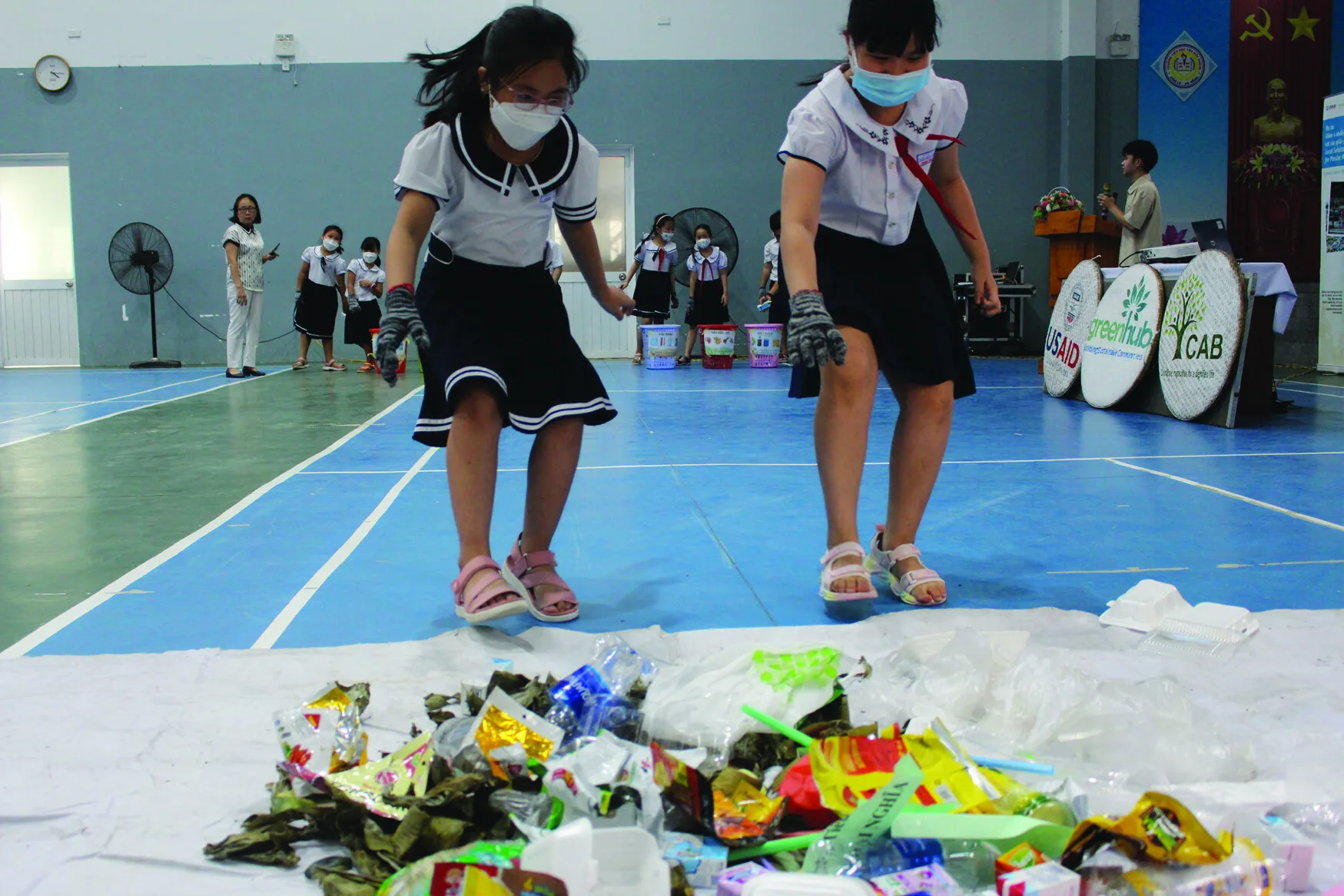
- 2.3. Assess plastic waste (waste audit) input and output — Method: Waste audit — Responsible: School/consultant — Duration: 10 days.
- 2.4. Launch the green-school-saying-no-to-plastic-waste model initiative — Method: Workshop/event — Responsible: Education Department, School — Duration: 1 day.
- 2.5. Provide knowledge and communication skills on the impact of plastic on health and skills in plastic-waste management and single-use-plastic (SUP) reduction — Method: Training 2 days/training/school — Responsible: School/consultant — Duration: 4 days/school.
- 2.6. Establish the school's environmental club — Method: Guidance on establishment/Training for the club — Responsible: School — Duration: 1 month.
- 2.7. Establish and build the monitoring-evaluation (MnE) team — Method: Guidance on establishment/Training for the monitoring team — Responsible: School — Duration: 1 month.
- 2.8. Carry out communication events and activities — Method: Small-group communication in class/Whole-school communication/Contest/Communication event — Responsible: School/Education Department — Duration: 3 months.
- 2.9. Segregate waste at source, collect recyclable waste to sell to scrap dealers, recycle other plastic waste — Method: Waste segregation — Responsible: School — Duration: 3 - 6 continuous months.
- 2.10. Assess the school's plastic-waste-management status after 6 months of implementation — Method: Assessment form — Responsible: School/consultant — Duration: 1 month.
- 2.11. Evaluate the green-school-saying-no-to-plastic-waste model initiative — Method: Conference — Responsible: DoET/school — Duration: 01 day.
- 2.12. Document and share through workshops/events — Method: Documentation/Conference — Responsible: DoET/School — Duration: 1 month.
Part III: Risks and solutions
- Epidemic risk;
- Storms/floods/extreme weather;
- Other risks.
To ensure effectiveness in organising implementation and clearly assigning roles, the DoET will issue an implementation plan. For example: At Cam Le, while implementing support for green schools saying no to plastic waste in Cam Le District, the DoET issued Plan No. 375/KH-PGDDT dated August 2022, Implementing the Model “Green school saying no to plastic waste” in 2022, guiding the organisation of activities suitable to the school's educational activities.
The Boards of Management of the selected pilot schools carry out the tasks:
- Issue a decision establishing the model's dedicated board;
- Review the school's activities to prepare for organising assessment activities;
- Make a list of teachers/students participating in assessment activities;
- Review the school's resources to coordinate organising activities.
Survey method:
- Teachers answer the survey form themselves on the KoBo website;
- Volunteers interview students and enter information into the survey form on the KoBo website;
- Determine the sample size using the sample-selection formula. For example, the survey sample at 3 schools in Cam Le is 656 samples randomly selected from a total of 2,761 students across 3 grade levels with an allowable error of 3.34% (Sample Size Calculator by Raosoft, Inc.);
- Raw data is processed automatically on the KoBo website, from which results are exported and a report written.
Baseline assessment. The baseline assessment is an activity designed to collect status information and input data to serve the design of activities and monitoring-evaluation. Baseline survey activities include: Survey of students' and teachers' knowledge, attitude and practice related to the plastic-waste topic; Survey of the status of waste management in general and plastic waste in particular at schools; and waste audit.
KAP survey. The objective of KAP is to assess how teachers and students understand and care about plastic waste and how they practise plastic-waste management, in order to have a suitable intervention plan; and to collect baseline information for comparison at the end of the project. The survey form includes:
- General-information section;
- Questions on waste-management knowledge;
- Questions on attitude towards waste management;
- Questions on waste-management practice.
In-depth discussion on waste management at school:
- About 20 students and staff of the schools share about the status of waste management at the schools;
- Advantages and obstacles are shared;
- Activities to maintain the green-school-saying-no-to-plastic-waste model in subsequent years are discussed;
- Group discussion through questions;
- Summarising the results of waste management at the school.
Waste audit. The survey on waste management provides the information:
- Obtaining a list, quantity, weight and volume of the types of waste on average per day at the school;
- Obtaining a list of brands, the type and amount of waste for each brand on average per day;
- Having enough teachers, staff, students and volunteers participating as planned and having their capacity in waste auditing strengthened;
- Waste is stored for 5 days before the audit day under the guidance of the consultant (CAB staff);
- Auditing (inventorying) each type, quantity, volume and weight of each type and brand and recording it. Organic waste is not counted;
- Carrying out the waste audit directly in the backyard of each school;
- The consultant and volunteers sit interspersed among students and school staff to observe and support when needed.
Assessing the school's waste status after 6 months. The objective is to assess the status of waste management at the school after 6 months of implementing the model. Obtaining information on results from the green-school-saying-no-to-plastic-waste model after 6 months of implementation to plan maintenance in subsequent school years and scale up the model at other primary schools.
Step 3: Implement the pilot plan of the green-school-saying-no-to-plastic-waste model
After the plan is agreed and issued in step 2, the schools, based on the assignment, organise the implementation of activities per plan.
a. Plan the timing of specific activities at each school
Each selected school, depending on the baseline-assessment results and preparation, makes a specific plan for its own school. Schools refer to the plan template in step 2 for the plan framework. Schools base on the KAP survey results, waste audit and assessment of the school's waste-management status to set objectives, implementation options and a suitable plan.
b. Training combined with providing behaviour-change communication skills
Training activities to raise knowledge and capacity on waste are carried out for both students and teachers of the selected schools. The training targets include teachers not yet trained in waste management, the impact of waste on health and solutions to reduce plastic waste, and teachers not yet trained in behaviour-change communication skills in school-waste management and SUP reduction. In addition, teachers who attended previous training courses can absorb new information and share existing knowledge with other teachers. Typically these training courses take place over 02 training days for the whole school's teachers. A training course programme is designed as follows:
Day 1:
- 7:30-8:30 Opening - Introduction to the training - Pre-test;
- 8:30-9:15 Topic 1: Impact of waste on health, environment and climate;
- 9:15-10:00 Topic 2: School-waste management;
- 10:00-10:15 Break;
- 10:15-11:00 Topic 2: School-waste management (continued);
- 11:00-13:30 Lunch break;
- 13:30-14:15 Topic 2: School-waste management (continued);
- 14:15-15:00 Topic 3: Solutions to reduce the use of single-use plastic products;
- 15:00-15:15 Break;
- 15:15-16:30 Topic 4: Communication concepts.
Day 2:
- 7:30 – 7:45 Review;
- 7:45-8:45 Topic 5: The steps of behaviour-change communication (BCC) and communication effectiveness;
- 8:45-9:45 Topic 6: Communication issues;
- 9:45-10:00 Break;
- 10:00-11:00 Topic 7: Group communication;
- 11:00-13:30 Lunch break;
- 13:30-13:40 Warm-up;
- 13:40-15:00 Topic 7: Communication planning;
- 15:00-15:15 Break;
- 15:15-16:00 Topic 7: Communication planning (continued);
- 16:00-16:30 Post-test – Wrap-up.
The results to be achieved from the training include:
- Teachers can present how waste affects health through images;
- Can explain the concept of school-waste management via a diagram of the waste path at the school;
- A list of solutions to reduce single-use plastic items is included in the school's policy;
- Strengthening behaviour-change communication skills for teachers;
- A communication plan is made by teachers and staff.
c. Establishing and building the environmental club
Each school's environmental club plays an important role in practising the action plan on waste management at the school and the communication plan.
Purpose of establishing the environmental club. The environmental club (EC) in the school is established to create conditions for students who love the environment to meet, share and discuss in order to have effective environmental-protection actions. When becoming an EC member, students are helped to:
- Have understanding of nature and the living environment in general;
- Have understanding of waste; the impact of waste, especially plastic waste, on human life and living species;
- Take specific actions to limit generating plastic waste and treat waste without causing environmental pollution;
- Raise a caring attitude and live responsibly towards the environment;
- Form related skills in teamwork, guiding students outside the EC and adults to act together for the environment.
Through regular activities, EC members will be provided with knowledge and skills related to environmental-protection activities:
- Nature and the living environment in general;
- Waste; the impact of waste, especially plastic waste, on human life and living species;
- Communication skills on related topics;
- Teamwork, planning and club-activity skills.
Preparing to establish the club. Obligations when participating:
- Actively and fully participate in activities to build and develop the EC;
- Comply with the EC rules (which the members themselves helped build).
EC participants (recommended):
- Students of grades 3, 4, 5;
- Students who love the environment and like to participate in environmental-protection activities;
- Voluntarily join the EC.
Registration period. Information on establishing the environmental club needs to be provided to students and parents within a certain period. This gives students and parents time to think before students decide to join and parents decide to agree to let their child join. Registration period: From the date of announcement until the end of day … month … 2022.
- Students register to join the Environmental Club with their homeroom teacher;
- The homeroom teacher makes a list and sends it to the teacher in charge of the EC – the EC Head;
- Issue a decision establishing the environmental club.
EC organisational structure. Like other interest groups, the environmental club in the school needs an organisational apparatus to build and develop a strong EC.
- EC Head: usually the school's Team leader/Youth-Union branch secretary. Role: manage and run the EC. Duties: run the planning of the whole EC and lead the EC to achieve its objectives; connect the EC to participate in other related activities; report periodically to the Principal.
- EC Deputy Head: Role: support the Head in running the EC. Duties: organise EC activities; mobilise member participation in EC activities; collect data, report to the EC Head.
- EC Secretary: Role: coordinate with the Deputy Head to organise EC activities. Duties: take minutes of the activity sessions; be in charge of logistics of activities; manage the EC's materials and learning tools.
- EC Members: Role: participate in establishing, building and developing the EC. Duties: participate in giving initiatives and contribute to EC-related decisions; participate in activities and other tasks when assigned.
Club activity content. Principles: The club operates based on the principles:
- The EC's activity plan is built with the participation of EC members;
- Activities are built with the objective of developing EC members' capacity in environmental protection (focusing on waste reduction).
Forms:
- Regular internal EC activities per plan;
- Carrying out planned activities. For example: Communication to all students under the flag, communication to classmates during class activity time, participating in extracurricular activities…;
- Participating in other school events.
Content:
- Building the EC charter;
- Electing the Committee/Group leaders such as: 1) Communication Committee, 2) Logistics Committee, 3) External-Relations Committee, 4) …;
- Building the EC activity plan;
- Providing related knowledge and skills to EC members;
- EC members carry out communication activities at the school per plan;
- EC members mobilise students outside the EC to participate in other related activities.
d. Plan communication and carry out communication with students
Communication is an important activity throughout the process of building and implementing the green-school model. Each school builds its own communication plan and organises implementation (diverse in many forms and channels). Communication materials are selected and used suitably to the student audience.
Step 4: Monitor – Evaluate - and share for scaling up
a. Establish the monitoring board, plan and monitoring tools
The board monitoring the model's implementation consists of responsible teachers at each school. The monitoring board is established and trained in monitoring methods and use of the monitoring form and is responsible for reporting to the school's Board of Management and the DoET. The monitoring plan includes the following items (each indicator states the method and evidence):
I. Target indicators:
- Volume of plastic waste from single-use products reduced by 20% — Method: Waste audit — Evidence: Waste-audit report;
- Amount of plastic waste from single-use plastic products used to hold food and drink reduced by 20% — Waste audit — Waste-audit report;
- Total volume of all waste types reduced by 20% — Waste audit — Waste-audit report;
- Number of students able to state the harm of waste to health increased by 20% — Interview — Report;
- Number of students able to give examples of the waste groups: 1) waste sellable to scrap dealers, 2) leftover-food waste, 3) other organic waste and 4) other waste, increased by 20% — Interview — Report;
- Number of students who consider that using plastic bags pollutes the environment increased by 20% — Interview — Report;
- Number of students bringing drinking water and beverages to school in containers that are not single-use items increased by 20% — Observation — Report;
- Number of students bringing food to school in containers that are not single-use plastic items increased by 20% — Observation — Report.
II. Green-school indicators of the City People's Committee:
- TC5. 100% of waste is collected, gathered and treated per regulations — Observation — Images, Information;
- TC7/M1. There is 1 whole-school environmental-protection communication campaign — Recording information, Taking photos — Images, Information;
- TC7/M4. There is integration of environmental-protection activities into the school's Young Pioneer movements — Recording information, Taking photos — Images, Information;
- TC7/M5. There is integration of environmental-education knowledge into subjects per the distribution of the Ministry of Education and Training — Recording information, Taking photos — Images, Information;
- TC7/M6. There is an experience initiative in integrating environmental education — Recording information, Taking photos — Images, Information;
- TC7/M7. The school organises an evaluation of the effectiveness of the integration and students' awareness — Group discussion — Images, Information.
III. Output indicators:
- All 39 classes carry out 2 in-class communication sessions — Recording information, Taking photos — Images, Information;
- All students have strengthened knowledge of the harm of plastic to health, how to segregate waste, how to reduce single-use plastic items, how to recycle — Recording information, Taking photos — Images, Information;
- Students are communicated to during the flag-raising ceremony — Recording information, Taking photos — Images, Information;
- All students have strengthened knowledge of the harm of plastic to health, how to segregate waste, how to reduce single-use plastic items, how to recycle through games during the flag-raising ceremony — Recording information, Taking photos — Images, Information;
- 1 recycling contest is organised — Recording information, Taking photos — Images, Information;
- Students of grades 3, 4 and 5 participate in the recycling contest — Recording information, Taking photos — Images, Information;
- At least each class has 1 usable product made from low-value plastic waste — Recording information, Taking photos — Images, Information;
- The whole school performs waste segregation (with segregation bins, collection bins, no waste burning) — Observation — Images, Information;
- Waste is placed correctly into the segregation bins (8/10 monitoring times) — Observation — Images, Information;
- Collecting waste to sell to scrap dealers is carried out — Recording information, Taking photos — Images, Information.
The monitoring form is a tool to monitor the indicators set out in the monitoring plan; the monitoring form may include:
- Small-group communication monitoring form;
- Schoolyard communication monitoring form;
- Single-use-plastic-reduction monitoring form;
- Waste-segregation monitoring form;
- Monitoring the change in students' awareness;
- Monitoring recycling and reuse.
b. Carrying out monitoring and supervision
From the monitoring plan, monitoring and supervision activities are carried out to draw experience, learn and adjust the approach to suit the operating context at each school. The monitoring board is responsible for carrying out and reporting monitoring results to the Board of Management, while proposing adjustments to make the approach effective and suitable.
c. Carrying out the output assessment
The output assessment includes: Knowledge - attitude - practice (KAP) survey on plastic waste at the school among teachers and students; In-depth discussion on waste management at the school; and Waste audit. Similar to the baseline-assessment activity, the output-assessment activity provides quantitative data to compare and evaluate the model's implementation results. The method and approach are similar to step 2 of the process guidance document.
Documentation and sharing for scale-up to schools across the District
- Share information on the results and lessons learned of the model implemented at the pilot schools;
- Discuss lessons and the roles of the parties in maintaining and scaling up the green-school-saying-no-to-plastic-waste model at schools in the district;
- Hand over the model results to the DoET and schools to continue maintaining and implementing.
For pilot models at the local level, documenting the process is an important product to summarise the implementation process and share it with stakeholders. This is the handover document for the locality to continue maintaining and scaling up within the locality. The model's activity results are reported to the DoET and stakeholders from the start of launching the model. Typically the wrap-up activity takes place in an event organised by the locality.