
Cam Le District, Da Nang City
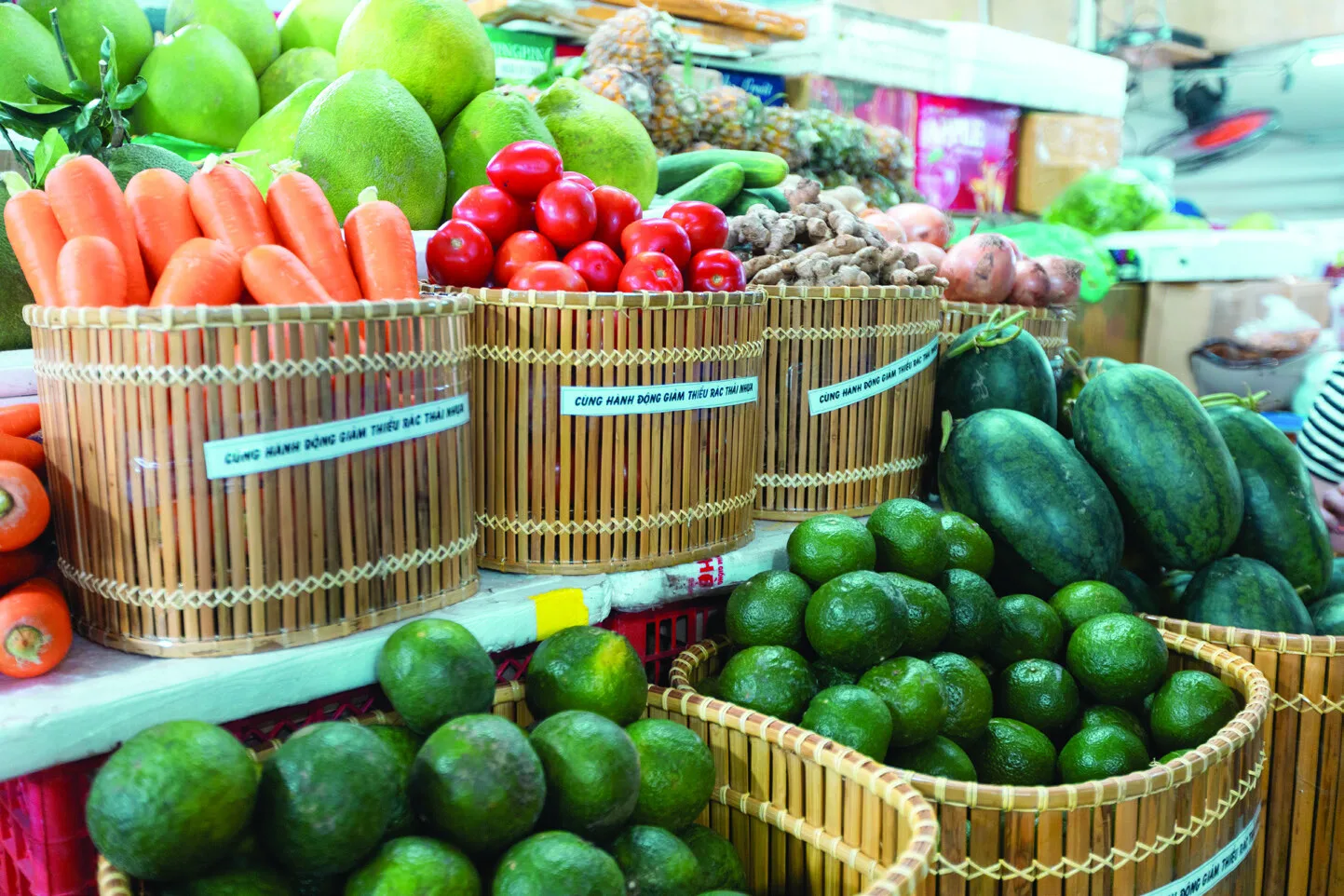
The plastic-waste-reduction traditional market model is implemented in Da Nang City, piloted at 6 markets in Cam Le district (Cam Le, Hoa Cam, Hoa Thuan Dong, Hoa An, Hoa Phat and Hoa Xuan markets). The model aims to change the awareness and behaviour of vendors and consumers to reduce the use of plastic bags and single-use plastic products at the market.
The process for building and implementing the plastic-waste-reduction traditional market model (Da Nang City) comprises 5 steps: (B1) Assess and analyse the context; (B2) Build a plan and reach consensus; (B3) Organise implementation; (B4) Evaluate and adjust; (B5) Document and share.
(i) Secondary-data research method. Secondary data plays an important role in analysing project-related issues. The consultancy team collected, systematised and analysed the following relevant materials:
(ii) Sociological survey. Assessing the awareness and behaviour of vendors and consumers at the market regarding plastic-waste-reduction practices was carried out to provide a baseline database supporting the Management Board to review, amend, supplement and develop policies on “Plastic-waste reduction” and plastic-waste management. Specifically:
The survey questionnaire was built based on the MOA theoretical framework to assess the behaviour of 2 target groups in plastic-waste-reduction activities, namely (i) vendors and (ii) consumers. The questionnaire has 4 main components:
The research scope in terms of space: implemented at 6 markets: Cam Le, Hoa Cam, Hoa Thuan Dong, Hoa An, Hoa Phat and Hoa Xuan markets. The research content covers the awareness and behaviour of vendors and consumers regarding plastic-waste-reduction behaviour. The research subjects are vendors of the meat and fish sector, the vegetable-fruit sector, the dry-goods sector (spices, rice paper, dried noodles) and other sectors (footwear, clothing, food and drink…) as well as consumers.
The overall assessment results reveal the characteristics of each sector and provide suitable proposals for the model. Through the preliminary survey, the sectors have different characteristics, so the composition and volume of waste in general and plastic waste in particular also differ. Case of analysing sectors and plastic-waste generation at Cam Le market:
1. Wet-goods group
2. Vegetable and fruit group
3. Dry-goods group
For the plastic-waste-reduction traditional market model, the main objectives set out include:
From the results of the sociological assessment and secondary-information analysis, the project team works with key stakeholders to discuss and confirm the issues to be addressed, while clarifying the needs and roles of stakeholders. Through meetings and exchanges, the model's objectives are identified and agreed among the parties. In the meetings, tools such as SWOT and stakeholder analysis are used.
Stakeholders are mobilised to participate in discussion meetings to build the joint action plan of the model. Through discussions, the roles of the parties are defined.
The model's implementation plan is built based on the agreement of stakeholders. The model's objectives may depend on the characteristics of each market. The model's initial objectives will contribute to the general objectives of the joint action plan (JAP) such as:
The model's framework plan includes the capacities to be strengthened for the market Management Board (MB):
The MB's capacity relates not only to knowledge of solid-waste management but also includes activity-organisation management capacity, including financial and planning management and strengthening coordination ability. Enhanced organisational capacity will help the MB maintain activities after the project ends.
Capacity-building training for MB staff and vendors is carried out at the markets.
Promoting the participation of vendors and businesses. Vendors are mobilised to participate in the activities of the plastic-waste-reduction traditional market practice. Households are informed about the model activities, and the MB needs to mobilise businesses related to alternative products to participate.
Communication. Communication activities need to be carried out regularly and throughout the model's operation. This must also be clearly shown in the model action plan built and agreed by stakeholders in step 2 of this process.
The approach of this model is to identify MB staff and vendors as the group that needs to change first and foremost. Turning a market into a green market takes time and step-by-step change, from changing awareness through communication activities and intervening with initiatives to reduce plastic consumption, especially plastic bags, to reinforce the attitude of vendors and customers and gradually form habits and rules of environmental behaviour (through reducing single-use plastic consumption at the market).
The pilot practice “Green stall without plastic bags” is carried out with the main activities:
For example, at Cam Le market, currently 10 vendors commit to participating in the green-stall-without-plastic-bags practice. Survey results show 8kg of biodegradable plastic bags are distributed daily to participating vendors in the dry, wet and vegetable sectors. Among these, the vegetable-fruit sector has the highest distribution rate, with 1.5kg of biodegradable plastic bags per day. Next is the wet sector, with an average consumption rate of 0.6 kg of biological bags per day. To facilitate vendors and consumers, the MB arranged a separate green-stall area right at the market gate both to supply alternative products to vendors and to allow interested customers to access them.
Based on the survey of consumers' plastic-emission needs, the activity encouraging bringing a shopping basket faced difficulties because customers travel directly from their workplace to the market to shop. Therefore, the project proposed the practice “Green shopping - Shopping without plastic bags” for consumers.
To implement the model's activities, the pilot teams are the core of the model. The pilot group comprises vendor households with a spirit of participating in plastic-waste reduction, who registered with the MB. For the pilot practice “Green shopping – Shopping without plastic bags” at Cam Le, 60 households in the residential area near the market signed a commitment with the MB. For the practice “Green stall without plastic bags”, 10 vendor households at Cam Le market registered a commitment.
Pilot households are supported with training and capacity building on solid-waste management at the market and waste-reduction practices. They are also prioritised for support with alternative products in the initial phase to promote companionship and communication to surrounding business households.
The market Management Board plays the role of coordinating and organising activities. To ensure effectiveness in organising implementation and clearly assigning roles, the MB issues an implementation plan. During implementation, meetings may be held to update implementation information and adjust activities appropriately. The Markets Management Board closely coordinates with the DoNRE, ward People's Committees and stakeholders in the model to effectively implement the activities per plan. The model activities need to be continuously maintained and become regular activities at the market. This contributes to strengthening the model's sustainability.
(i) Assessing the change in awareness of vendors across sectors. A survey was carried out with the participation of vendors doing business at the market to assess the change in the awareness of vendors and the management board about plastic pollution at the market. The assessment of awareness change can be conducted after training courses. For example, at Cam Le market, the training “Advocacy, enhancing implementation of the WSS model and reducing plastic use” was carried out with the participation of 120 vendor households and 20 staff of the market management board and local authorities. The assessment of participants' awareness change after training recorded: (i) 26% of vendors changed their daily habit of using plastic bags and SUP plastic products; (ii) 14% of vendors used biodegradable plastic bags in business; and (iii) 69% of vendors signed and implemented commitments to reduce plastic waste in their business at the market.
The recorded change contents include: commitment to reducing waste; change in plastic-bag-use behaviour; change in behaviour of advocating to buyers; self-implementation of plastic-reduction behaviour.
For example, at the Cam Le market model, a survey was carried out and recorded outstanding results: (i) 80% of vendors fully agreed that implementing the commitment would sustainably reduce plastic-waste volume, specifically using biodegradable plastic bags in business with minimum emissions or using paper bags for the dry sector to replace plastic bags; (ii) 75% of vendors agreed to advocate the green plastic-waste-free shopping form; and (iii) more than 50% of vendors committed to changing their daily habits, specifically equipping themselves with a bag when going to the supermarket and a food container when buying food.
(ii) Assessing the change in plastic-reduction behaviour of vendors across sectors. Based on the awareness-change assessment results, a behaviour-change survey was carried out. The assessment method is similar to the awareness-change assessment. The questionnaire is designed to suit the interventions described in the model implementation plan.
Assessing the suitability and feasibility of alternative products. To assess the practical feasibility of the 02 pilot practices, a survey was carried out with the aim of assessing the suitability and feasibility of alternative products (such as paper bags, reusable plastic boxes, glass bottles…). In addition, assessing the suitability of the approach also needs to be done to understand how the model operates and the participation of vendors and residents. The assessment results will contribute to adjusting the approach in the model and selecting suitable alternative products. At Cam Le, the assessment results recorded:
Analysing difficulties and advantages in implementing the model. A group interview was carried out to identify the difficulties and advantages of vendors in implementing the pilot plastic-reduction model at the market. Survey results show that the applicability of biodegradable plastic bags is one of the obstacles of plastic-reduction practice, specifically: (i) product price; (ii) product design; and (iii) product material, which do not meet product-consumption needs. In addition, negative reactions from customers create hesitation among vendors when converting to alternative products and reducing plastic. For example, at Cam Le market:
Advantages:
Difficulties:
The model results need to be compiled in a report to inform local management agencies as required by the joint action plan (JAP). Besides reporting to management agencies, the report will help share information with parties interested in the model. As an example, for Cam Le market, after reporting at the project's second-year workshop in Hoi An, the representative of Hoi An market expressed interest and a desire to exchange and learn the approach. In addition, documenting the project implementation process is an important product, contributing to promoting the model's scale-up in the future.
The model's scale-up potential needs to be assessed objectively with the model's subjects to understand its sustainability and from there propose scale-up activities. At Cam Le market, based on the survey results, the alternative products proposed in the green-stall-without-plastic-bags practice were assessed as having scale-up potential, specifically: (i) 66% for paper bags replacing at the dry sector; 82% for plastic boxes and glass bottles at the food and wet sectors; and 52% for biodegradable plastic bags at all sectors. However, the survey data also recorded that the scale-up scope of this product is limited, specifically only 33% of vendors considered this model can continue to be piloted at the sector or at other markets. For the pilot mesh-shopping-bag rental practice, more than 50% of vendors considered this model can be scaled up and at a large scale. The reason considered is that the model ensures a balance of economic and environmental benefits for vendors and consumers when operating at the market. Specifically, vendors reduce the cost of buying and stocking plastic bags, and consumers are given a comfortable feeling, not being pressured when shopping.